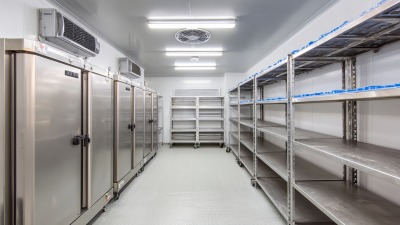
Thinking about picking the best cold room manufacturer in China for your global needs? Well, a winning quote isn’t the whole story. You want to work with someone you can trust—they should really get the ins and outs of temperature control, insulation quality, keeping food safe, planning the setup, and maintaining everything smoothly down the line. You'll notice experience in the little things, like properly sealed panel joints, doors that open and close without fuss, steady refrigeration systems, and smart drainage designs. It’s those details that make all the difference.
A solid cold room manufacturer should also be able to provide clear documentation—things like specs for polyurethane panels, evaporators, condensing units, controllers, and alarms. Don't be shy about asking for factory quality records, component traceability, testing procedures, and references from similar projects they’ve handled. For instance, a walk-in freezer at -18°C needs a different setup compared to a vegetable storage room kept between 0°C and 5°C. Even small mistakes with design can lead to higher energy bills or uneven temperature distribution—that’s why paying attention to the details is so important.
And don’t forget, honest manufacturers will communicate clearly right from the start. They should confirm critical things—like room dimensions, how often it will be loaded, the local environment, power needs, delivery schedules, and who’s responsible for installation. It’s also good to know which parts they make in-house and which they source from trusted brands. Of course, no supplier is perfect, and performance can vary. So, a smart buyer compares evidence rather than just taking shiny promises at face value.
Before making a final decision, it’s essential to verify local certifications and safety standards, because requirements can differ from one market to another. Overall, this isn’t about blindly supporting one company, but about figuring out who can truly deliver a safe, efficient, and easy-to-maintain refrigeration system. Proof of quality really does speak volumes.
China’s cold room manufacturing covers far more than insulated boxes. It includes temperature-controlled panels, doors, refrigeration units, electrical controls, monitoring systems, installation, and maintenance support. Manufacturers may also provide testing, airflow adjustment, and commissioning for food, pharmaceuticals, flowers, and laboratory materials. The boundary is not always clean. Some suppliers build complete rooms, while others only assemble selected components.
Demand continues to expand. The China Federation of Logistics and Purchasing estimated China’s cold-chain logistics market at about RMB 517.9 billion in 2023. Globally, the International Energy Agency reports that cooling demand is rising with urbanisation and higher food-quality expectations. These figures matter because a cold room is an operating system, not a metal enclosure. Wall thickness, door-opening frequency, product loading, ambient temperature, and refrigerant selection affect real performance. In practical projects, a room can meet its design temperature yet waste energy through poor sealing. That is an uncomfortable but common gap.
Tips: Global buyers should request thermal calculations, temperature-mapping records, component specifications, and maintenance procedures. Ask how the manufacturer verifies performance after installation. The UNEP 2023 Global Cooling Watch report also highlights the need for efficient equipment and lower-emission cooling solutions. Therefore, buyers should examine energy consumption, refrigerant compliance, and spare-parts availability, not only the initial quotation. A factory visit helps, but it cannot replace documented testing.
Choosing a cold room manufacturer requires more than comparing panel prices. The 2023 Global Cold Chain Capacity Report recorded about 719 million cubic metres of temperature-controlled storage worldwide. This scale reflects rising demand, but it also exposes weak engineering. Ask for verified U-values, door leakage data, pull-down time, and temperature uniformity records. A reliable supplier should explain how the room performs at your local ambient temperature, not only in laboratory conditions.
Energy performance deserves close attention. The International Institute of Refrigeration estimates that refrigeration uses around 17% of global electricity. Efficient compressors, correctly sized evaporators, insulated floors, and automatic door closers can reduce operating waste. Refrigerant selection should also consider safety, service availability, and applicable environmental rules. Request test certificates, wiring diagrams, maintenance schedules, and a clear warranty response time. Good documentation matters.
During commissioning, measure temperatures at several points, including corners and near doors. A single sensor can hide real failures. The manufacturer should provide calibration records and practical training for operators. Food safety systems should align with recognized HACCP principles and applicable local requirements. However, no supplier is perfect; installation quality, loading habits, and delayed maintenance can still damage performance. That uncomfortable fact should be discussed before signing the contract. A cheaper quotation may become expensive when energy bills, spoiled inventory, or unavailable spare parts appear.
Global buyers need more than a low temperature and an insulated door. The right cold room depends on product sensitivity, loading frequency, and local climate. FAO’s State of Food and Agriculture 2019 reported that 13.2% of food is lost between harvest and retail. Proper refrigeration can reduce part of this loss, but poor airflow can create warm corners.
Chilled rooms usually operate between 0°C and 5°C for vegetables, dairy products, and fresh meat. Frozen rooms commonly maintain -18°C or lower for long-term storage. For rapid freezing, blast-freezing rooms may reach -30°C to -40°C. They protect texture better than slow freezing. Pharmaceutical cold rooms often use a controlled 2°C to 8°C range, supported by calibrated sensors and alarm records. Small differences matter.
Controlled-atmosphere rooms suit selected fruits by managing oxygen, carbon dioxide, and humidity. They cost more and require trained operators. The International Institute of Refrigeration has linked refrigeration access with food security and reduced waste, yet energy use remains a serious concern. Buyers should compare insulation thickness, defrost design, refrigerant safety, and backup power. A larger room is not always better. I have seen projects overestimate future demand, leaving expensive space underused. Capacity planning needs real shipment data, not optimism. Temperature mapping should be repeated after installation, especially in hot regions. A perfect specification can still fail during daily loading.
| Cold Room Type | Typical Operating Temperature | Typical Product Core Temperature | Common Applications | Typical Modular Size Range | Key Design Considerations |
|---|---|---|---|---|---|
| Chilled Storage Room | 0°C to +5°C | Usually 0°C to +4°C, depending on the product | Dairy products, fresh meat, seafood, prepared foods, beverages and short-term produce storage | Approximately 2 m × 2 m to 12 m × 20 m; customized layouts are common | Good air circulation, humidity control, hygienic surfaces and frequent door-opening management |
| Frozen Storage Room | Typically -18°C to -25°C | Generally -18°C or colder for long-term frozen-food storage | Frozen meat, seafood, vegetables, ice cream, bakery products and packaged frozen foods | Approximately 2 m × 2 m to 15 m × 30 m; capacity depends on pallet configuration | High-performance insulation, vapor protection, heated door frame, floor insulation and defrost control |
| Blast Freezer | Usually -30°C to -40°C air temperature | Often targets -18°C or lower at the product core | Rapid freezing of meat, fish, poultry, prepared meals, fruit and bakery products | Small batch rooms from about 2 m × 2 m; industrial rooms may exceed 10 m × 20 m | High refrigeration capacity, powerful air movement, product loading rate and freezing time must be calculated together |
| Blast Chiller | Approximately -5°C to +3°C air temperature | Rapidly reduces hot food to a chilled holding temperature, commonly around +3°C | Commercial kitchens, catering, ready meals, bakery products and central food production | Cabinet units for trays up to larger rooms for trolley loading | Uniform airflow, tray spacing, food load, probe monitoring and sanitation are critical |
| Fruit and Vegetable Cold Room | Approximately +2°C to +12°C, product-specific | Varies widely; many commodities require controlled temperature and humidity rather than freezing conditions | Fresh fruits, vegetables, herbs, flowers and other horticultural products | Approximately 3 m × 3 m to 15 m × 30 m | Commodity-specific temperature, relative humidity, ventilation, ethylene management and compatibility are important |
| Meat and Seafood Cold Room | Chilled: 0°C to +4°C; frozen: -18°C to -25°C | Chilled products are normally kept near 0°C to +4°C; frozen products at -18°C or below | Slaughterhouses, seafood processors, wholesalers, supermarkets and food distribution centers | Small processing rooms to large pallet or hanging-rail storage facilities | Washable panels, corrosion-resistant hardware, floor drainage, hygienic doors and loading-zone separation |
| Pharmaceutical Cold Room | Commonly +2°C to +8°C; other ranges may be specified by the product | Must remain within the validated storage range stated by the manufacturer or product specification | Medicines, vaccines, biological materials, laboratory reagents and temperature-sensitive healthcare products | Typically compact rooms or cabinets, with larger systems for warehouses and distribution hubs | Continuous monitoring, alarms, calibrated sensors, backup power, access control and documented temperature records |
| Ripening Room | Commonly about +14°C to +22°C, depending on the commodity and process | Managed according to the desired ripeness stage and distribution schedule | Bananas, avocados, mangoes, tomatoes and other climacteric fruit | Usually designed for palletized loads, from small chambers to high-volume rooms | Controlled temperature, humidity, airflow and ethylene concentration; airtight construction may be required |
| Walk-In Cooler or Freezer | Cooler: 0°C to +5°C; freezer: typically -18°C to -25°C | Determined by the stored product and applicable food-safety requirements | Restaurants, convenience stores, supermarkets, hotels, laboratories and small distribution facilities | Often about 1.5 m × 1.5 m to 6 m × 10 m | Fast installation, modular panels, efficient door operation, shelf clearance and available electrical power |
Note: Temperature ranges and room dimensions are typical planning references. Final specifications should be calculated from the product, required pull-down time, ambient climate, loading pattern, door-opening frequency, insulation thickness and local safety regulations.
A reliable cold room manufacturer serves global buyers through measurable standards, not attractive promises. Production should follow a documented quality system, with controlled drawings, approved materials, and traceable inspection records. Insulated panels need consistent core density, tight joints, and protected vapor barriers. A small gap can become a serious source of condensation and energy loss.
Modern manufacturing combines CNC panel cutting, foaming equipment, digital temperature monitoring, and tested refrigeration controls. Sensors should be calibrated before shipment. Refrigeration systems also require pressure testing, leak checks, electrical safety inspections, and performance trials under realistic loads. Qualified engineers should review ambient temperature, product type, door frequency, and installation conditions before selecting equipment. One standard design cannot fit every market.
Quality control must continue after assembly. Inspectors can measure panel thickness, surface flatness, door sealing pressure, and temperature recovery time. Export documents should identify materials, test results, operating limits, and maintenance requirements. Honest manufacturers should explain what their systems cannot guarantee. Field performance may change because of poor installation, unstable power, or incorrect loading. That is easy to overlook. Continuous feedback from installers and buyers helps correct weak details, even when the factory process appears successful.
Choosing a cold room manufacturer in China requires more than comparing export prices. Practical experience shows that customization affects installation speed, product safety, and long-term operating costs. A reliable supplier should review your storage temperature, daily loading volume, door frequency, and available floor space. Small details matter. For example, a frequently opened door may need a heated frame, strip curtains, or a faster-closing design.
Customization should include panel thickness, internal layout, refrigeration capacity, shelving, lighting, and control systems. Good engineering begins with heat-load calculations, not a standard quotation. Ask for technical drawings and material specifications. Check insulation density, joint sealing, compressor selection, and temperature records from similar projects. A manufacturer with clear documentation is easier to evaluate and support.
Production capacity also deserves careful attention. A large factory is not automatically the best choice. Confirm whether it can manage your required quantity without weakening quality control. Energy efficiency depends on the complete system, including insulation, evaporators, fans, defrost settings, and maintenance access. High-efficiency components can reduce electricity use, but poor installation may erase those benefits. This is often overlooked.
No project is perfectly optimized. I have seen buyers overspend on equipment while ignoring door discipline and insulation damage. That mistake is understandable, but costly. Request performance assumptions, warranty terms, spare-parts plans, and remote support before signing. Independent inspection can reveal uneven panels or incomplete wiring that photographs may hide.
For global buyers, choosing the best cold room manufacturer involves more than comparing prices. A capable manufacturer should manage export services, technical design, and documentation together. Export support begins with accurate quotations, clear Incoterms, strong packaging, and complete shipping documents. The supplier should provide drawings, packing lists, invoices, and installation instructions before dispatch. Documentation must match the destination country’s customs and electrical requirements. It should also explain lead times, warranty coverage, and spare-part availability in plain language. Small errors can delay a project.
Certification requirements differ by market and equipment type. Ask for relevant conformity documents, factory test reports, and material specifications before placing an order. Installation quality affects temperature stability, energy use, and product safety. Experienced technicians should check panel joints, vapor barriers, door seals, drainage, electrical connections, and refrigerant systems. Commissioning should include temperature testing under realistic operating conditions. Photos and test records create useful evidence for remote projects.
After commissioning, reliable support should not disappear. A practical service plan includes remote troubleshooting, replacement parts, maintenance guidance, and defined response times. Local technicians may need video instructions or translated manuals. No project stays perfect. I would still inspect every seal and sensor twice, because minor faults often appear after loading. Some manuals are technically correct but difficult to use. That weakness deserves honest correction, not marketing language.
: Services may include insulated panels, doors, refrigeration units, controls, monitoring systems, installation, and maintenance. Some suppliers provide complete rooms. Others assemble selected components only. Confirm the exact project boundary before ordering.
Share the storage temperature, daily loading volume, door frequency, floor space, and product type. Ask for heat-load calculations and technical drawings. Customization may include panel thickness, shelving, lighting, evaporators, and control systems. A standard quotation may hide important assumptions.
Wall thickness, joint sealing, door openings, product loading, ambient temperature, and refrigerant selection all matter. A room can reach its target temperature yet waste energy through poor sealing. That gap is common. Inspect door frames and panel joints carefully.
Review insulation, compressors, evaporators, fans, defrost settings, and maintenance access together. Efficient components cannot solve poor installation. Ask for estimated electricity use under realistic operating conditions. The cheapest quotation may cost more later.
Confirm the factory’s monthly output, quality-control process, testing equipment, and project experience. A large facility is not automatically better. Ask whether your quantity can be completed without rushed inspections. That risk is easy to underestimate.
Request drawings, packing lists, invoices, installation instructions, warranty terms, and spare-parts information. Incoterms and lead times should be written clearly. Documents must match destination customs and electrical requirements. Small mistakes can delay delivery.
Technicians should inspect panel joints, vapor barriers, door seals, drainage, wiring, and refrigeration connections. Commissioning should include temperature testing under realistic loading conditions. Request photographs, test records, and temperature-mapping results. Remote projects need stronger evidence.
Useful support includes remote troubleshooting, replacement parts, maintenance guidance, translated manuals, and defined response times. Local technicians may need video instructions. Inspect seals and sensors again after loading. Minor faults often appear later.
Choosing the best Cold Room manufacturer in China requires more than comparing prices. Global buyers should evaluate a manufacturer’s production experience, engineering capabilities, material quality, temperature control systems, and ability to deliver reliable solutions for different applications. Available options may include walk-in cold rooms, freezer rooms, blast freezers, pharmaceutical storage rooms, and customized units for food, logistics, hospitality, and other temperature-sensitive industries.
A qualified manufacturer should follow recognized manufacturing standards, use efficient insulation and refrigeration technologies, and maintain strict quality control throughout design, assembly, and testing. Buyers should also consider customization options, production capacity, energy efficiency, lead times, and long-term operating costs. Comprehensive export services, accurate documentation, relevant certifications, professional installation guidance, spare parts availability, and responsive after-sales support are equally important. By assessing these factors together, international customers can select a dependable partner capable of providing safe, efficient, durable, and well-supported cold storage solutions.